

PAUL GUIRAGOSSIAN
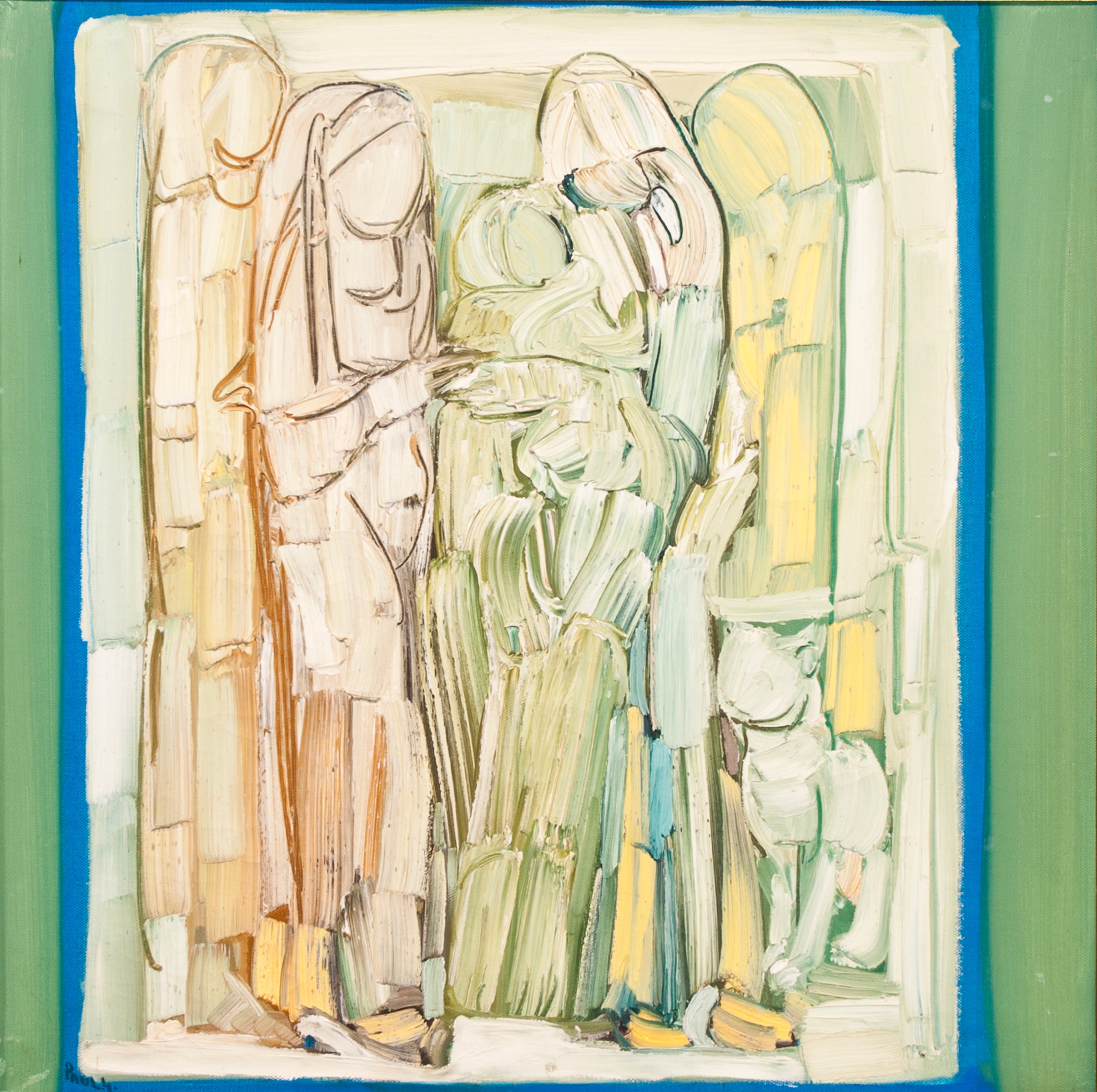
“THE NEW BORN” (1969)
Oil on canvas, 80 × 80 cm
THE ARTIST
Paul Guiragossian (1926–1993) stands as one of the most significant Arab modernist painters of the 20th century. Born in Jerusalem on December 25, 1926, to Armenian parents who survived the 1915 Armenian Genocide, Guiragossian’s life was defined by displacement and the search for belonging. Following the 1948 Arab-Israeli War, his family fled to Beirut’s Armenian quarter of Bourj Hammoud, where he would spend most of his creative life.
His artistic training began in Jerusalem studying religious iconography with Italian painters—an experience that profoundly influenced his treatment of sacred and maternal themes. The elongated figures and spiritual aura of icon painting left an indelible mark on his developing style. In 1956, he received a scholarship to study at Florence’s Accademia di Belle Arti, followed by further studies in Paris in 1962 at Les Ateliers des Maîtres de l’École de Paris, where he encountered European modernism, Surrealism, and the bold abstractions of Picasso and Matisse.
Returning to Beirut in the mid-1960s, Guiragossian emerged as Lebanon’s preeminent artistic figure. His work explored recurring themes: motherhood and childhood, communal gatherings, labor and struggle, and above all, the human figure as a vessel of memory and longing. His paintings are held in major collections including the Centre Georges Pompidou (Paris), Mathaf: Arab Museum of Modern Art (Doha), Jordan National Gallery of Fine Arts (Amman), and the Sursock Museum (Beirut). His auction record stands at $605,000 USD for “La Lutte de l’Existence” (Christie’s Dubai, 2013).
THE WORK
Composition and Meaning
“The New Born,” painted in 1969, presents a cluster of elongated, abstracted figures gathered around a central focal point—the newborn child. The figures are rendered with minimal facial detail, their features suggested rather than delineated, creating an anonymous, archetypal quality that transforms them into universal symbols of family and community. Arms are wrapped protectively around the unseen infant, suggesting tenderness, vulnerability, and the instinctive communal response to new life.
The composition is tightly compressed within the square format (80 × 80 cm), creating intimate enclosure. The figures press against one another, their elongated bodies forming vertical rhythms—a visual metaphor for the protective circle that surrounds every newborn.
The year 1969 holds particular biographical significance. Guiragossian’s son, Ara, had died shortly after birth years earlier, a loss that haunted him throughout his life. The theme of the newborn appears repeatedly in his work as both memorial and meditation on life’s fragility. For an artist born into a family of genocide survivors, whose existence was defined by exile, the image of a newborn carries profound symbolic weight—representing continuity, resilience, the refusal to be erased.
Palette and Technique
The palette features ochres, umbers, muted greens, soft blues, and warm grays—colors drawn from Beirut’s working-class neighborhoods. These earthy tones evoke both humble circumstances and timeless, ancient quality, as if the figures exist outside specific time and place. Touches of brighter color highlight the central drama, while the restrained palette reinforces the solemnity of birth and renewal.
Guiragossian’s technique reflects his mastery of impasto and expressive brushwork. Paint is applied thickly with visible, gestural strokes creating richly textured surface. This physicality gives the work sculptural quality, as if figures emerge from canvas itself. The brushwork balances between careful articulation and loose passages that border on abstraction—the figures remain recognizable yet resist literal reading, existing in a liminal space between representation and pure painterly expression.
PROVENANCE AND EXHIBITION
“The New Born” was included in the landmark retrospective “Paul Guiragossian: Testimonies of Existence” (Barjeel Art Foundation, UAE, 2018), marking the 25th anniversary of the artist’s death. The exhibition brought together paintings from the late 1950s to early 1990s from UAE collections and the Paul Guiragossian Foundation archive.
The work is documented in the exhibition catalogue “Testimonies of Existence: Paul Guiragossian” (Barjeel Art Foundation, 2018, ISBN 978-1-911561-03-3), featuring essays by Maisa Al Qassimi and Mandy Merzaban. According to the catalogue, “The New Born” is part of the Collection of Mr. François Faure, a significant collector of Middle Eastern modern art.
Authentication: Paul Guiragossian Foundation, Beirut. Certificate of Authenticity provided.
MARKET CONTEXT
Paul Guiragossian’s market has seen steady growth over two decades, driven by increasing institutional recognition. Works from the 1960s and early 1970s—the period of “The New Born”—are particularly sought after, representing his transition to mature synthesis of figuration and abstraction.
Recent comparable auction results:
- “Oriflamme” (1969), oil on canvas: £27,720 GBP (approximately $35,000–$40,000 USD)
- 1960s works in 80 × 80 cm format: $30,000–$80,000 USD
- Mother-and-child themed works consistently command premium prices
Given the provenance (François Faure Collection), exhibition history (Testimonies of Existence, 2018), publication (Barjeel catalogue), and powerful subject matter, “The New Born” is positioned at the higher end of the market for 1960s Guiragossian paintings.
SPECIFICATIONS
Medium: Oil on canvas
Dimensions: 80 × 80 cm
Date: 1969
Signature: Signed by the artist
Condition: Excellent. Original surface intact; colors vibrant; impasto preserved; canvas stable with no tears, losses, or restoration
Frame: Framed
Authentication: Paul Guiragossian Foundation, Beirut. Certificate of Authenticity included
Private viewings by appointment in Dubai
Worldwide shipping with full insurance and export documentation
Resources:
Paul Guiragossian Foundation: www.paulguiragossian.com
Barjeel Art Foundation: www.barjeelartfoundation.org
Choose options